
FBKTIM: The Inner Sense of Movement
FBKTIM: The Inner Sense of Movement
1 hour 30 minutes
The instructors
Overview
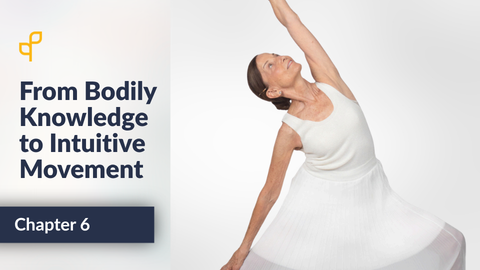
From Bodily Knowledge to Intuitive Movement (FBKTIM) is a seven-part live series with physical and yoga therapist Sherry Brourman, built chapter by chapter from her book of the same name. Each session unpacks one chapter, bridging physical therapy, yoga therapy, and pain science into a framework you can bring straight into your own practice, with research assistant Gina moderating.
This session covers Chapter 6: The Inner Sense of Movement. New to the series? Start with the free introductory session to see how it all connects, or see the full series and register here.
It is highly recommended that you have a copy of the book to accompany this series. You can purchase a copy of the book from Amazon or Singing Dragon, and you can learn more about the book on Sherry's website.
About Chapter 6: The Inner Sense of Movement
Where are the words? At the height of a movement experience that embodied everything I had been writing about, I searched for words to describe what I was doing and realized there were none. Chapter 6 takes the journey from outward to inward, where the bodily knowledge developed throughout this book can become an inner sense of movement.
Anatomy, movement patterns, breathing, ground reaction force, tensegrity, interoception, and whole-person awareness become ingredients of felt movement rather than instructions for how a posture should look and behave. Energetic Symmetry (ES), structural integrity with fluidity, offers transitional language for exploring these relationships within each unique personal movement system, without requiring ideal strength, flexibility, or neutral joint positions.
A 12-posture ES self-assessment offers an opportunity to first experience these principles in your own body. Each template posture explores directional energetics, plays of opposites, weight distribution, breath, sensation, and the amount of resistance and challenge that feels appropriate. Pose Applications and Planes of Movement use familiar elements within each template and the predominant planes in which they move to make other postures easier to recognize and understand.
As the feeling of personal structural integrity with fluidity becomes familiar, each practice can begin with a special kind of innocence. Current breathing patterns and stamina are the choreographers of this dance, inviting us to take in the movement experience as a meditation.
With practice, the need for external instruction and internal chatter becomes less and less. There is no particular way movement needs to look. As our bodies change and the science of movement continues to deepen, staying curious and engaged with emerging knowledge keeps the practice alive—allowing what we know, what we feel, and how we move to continue informing one another.
Learning Objectives
In this final chapter, we will:
- Develop a feel for their personal anatomy and its directional energetics during movement when they choose to notice.
- Use experience from previous chapters and personal movement history to explore current mood, sensation detection, self-talk, and response systems throughout the 12-posture assessment.
- Practice the postures by simple feel, with less chatter, and explore the increasing role of inner awareness in guiding movement.
- Recognize that as we and the field evolve, continued exploration, study, and practice remain part of an ongoing process of learning and self-healing.
- Apply energetic symmetry within postures and throughout transitions, whether moving or still, in ways that contribute to structural integrity with fluidity without requiring visual symmetry, prescribed alignment, or a particular way movement needs to look.
- Develop enough familiarity with postures and transitions that breathing patterns, stamina, sensation detection, and energetic feel can increasingly guide the practice rather than external cuing.
- Recognize and respond to our own and our patient/client’s changing capacities and longings for challenge, including bodily, mental, social, and spiritual influences, through communication and collaboration.
- Choose and vary internal resistance during breath and movement, moving as if through air, clouds, water, or honey, and consider the implications of those choices for today’s posture, sequence, or practice.
- Recognize the role of intention in movement, yogic homeostasis, and salutogenesis while honoring the individual history, capacities, experience, and felt sense that make each movement expression unique.
Audience
Details and What's Included
- Access to the live webinar
- Live Q&A: bring your clinical questions
- Downloadable slides/resources
- Reference list
- Lifetime access to the recording
- Certificate of completion
- 2 CEUs for US PTs and PTAs in approved states
Continuing Education Units (CEUs) for U.S. PTs and PTAs
This webinar provides 2 CEUs for eligible participants.
Embodia is a rule-approved CE provider of the PT Board of Florida (# 50-54793), a licensed CE sponsor of physical therapy continuing education by the Illinois Department of Financial & Professional Regulation (IDFPR #216.000415), an approved provider of continuing education by APTA Massachusetts, an approved provider of the Oklahoma Board of Medical Licensure & Supervision - Physical Therapy (#50-54793), and an approved provider of continuing education for Physical Therapists and Physical Therapist Assistants in California (CA) by CEUapproval.com, a recognized approval agency of the Physical Therapy Board of CA.
Courses approved by other state boards in the following jurisdictions are likely accepted for licensure credit based on the state regulation:
AL | AK | AR | CO | CT | DE | GA | HI | ID | IN | IA | KS | KY | ME | MI | MO | MT | NE | NH | NC | ND | OR | PA | RI | SC | SD | UT | VT | VA | VI | WA | WI | WY
Please reach out to your state licensing board to confirm. If you have a specific question about CEU approval for this course in your state, please direct your inquiry to info@ceuapproval.com.
The following states are not pre-approved: AZ, DC, LA, MD, MN, MS, NM, NV, NY, NJ, OH, TN, TX, WV
Participants licensed in states not pre-approved may file for individual approval using the instructions on this document.
The instructors
PT, C-IAYT

C-IAYT
Gina Shelton, C-IAYT, is a pediatric yoga therapist with the Pain Management team at Cook Children’s Medical Center in Fort Worth. Gina works with outpatient persistent pain patients and hospitalized patients with GI pain, chronic headaches and migraines, epilepsy, cancer, eating disorders, cardiac issues, anxiety around treatment for injuries & accidents, as well as patients in intense neuro rehab.
Gina completed her yoga therapy program at Loyola Marymount University in 2010, and became a certified yoga therapist through International Association of Yoga Therapist in 2017. Gina was also the research & editorial assistant of the recently released book From Bodily Knowledge to Intuitive Movement: Where Yoga Therapy, Physical Therapy and Pain Science Meet by Sherry Brourman, PT, C-IAYT.