
Heavy Slow Resistance Training for Tendinopathy: Achilles, Patellar & Elbow
By: Tavin Sharp, 2nd year UofT MScPT student ∙ Estimated reading time: 8 minutes
By: Tavin Sharp, 2nd year UofT MScPT student ∙ Estimated reading time: 8 minutes
Rethinking Tendinopathy: Why Heavy Slow Resistance Training is the New Gold Standard
Have you ever had a patient abandon their Achilles tendon rehab because they simply couldn’t keep up with the grueling demands of twice-daily, painful heel drops? For years, the Alfredson protocol and isolated eccentric loading were the undisputed kings of tendon rehab. We asked our patients to perform high-volume, often uncomfortable routines up to 14 times a week. It worked, but it was a massive ask for patient compliance and often led to increasing pain and frustration.
Heavy Slow Resistance (HSR) training stands out as an evidence-based, highly effective approach for managing chronic tendinopathy. This method involves performing high-load isotonic exercises, typically around 70% of one-repetition maximum (1RM), equivalent to approximately 7RM, executed slowly with controlled form to maximize time under tension.
The Evolution of Tendon Health Paradigms
Over the last several years, our understanding of tendon health and adaptation has shifted dramatically. The clinical paradigm is moving away from the dogmatic requirement of painful, isolated eccentric exercises toward more effective and patient-friendly approaches that allow tendons to thrive.
Research, including the gold-standard randomized controlled trial published in prominent journals such as the American Journal of Sports Medicine and Br J Sports Med, demonstrates that HSR yields significant improvements in both symptoms and function for conditions like Achilles tendinopathy and patellar tendinopathy.
What is Heavy Slow Resistance (HSR)?
Heavy Slow Resistance training focuses on high-load isotonic movements performed with prolonged time under tension. The classic prescription is a deliberate 6-second repetition: a 3-second concentric phase followed immediately by a 3-second eccentric phase, executed just 2 to 3 times per week.
By forcing a longer total repetition time, HSR maximizes time under tension, while the heavy load ensures adequate strain without requiring explosive energy storage activities that typically aggravate irritable tendons.
Why HSR Matters for Patients With Tendon Pain
When a patient presents with debilitating tendon pain, the goal isn't just to "fix" the tissue, it's to restore the body's ability to handle load. HSR addresses this by:
- Reducing Inflammation: The slow, controlled motion reduces joint shear forces and minimizes inflammation, allowing the area to heal effectively.
- Improving Load Tolerance: Systematic loading increases the threshold at which a patient experiences a pain response.
- Enhancing Muscle Strength: By targeting the entire kinetic chain, we improve the muscle's capacity to support the tendon.
Therapeutic Equivalence vs. Traditional Eccentrics
Recent network meta-analyses show no statistically significant difference in long-term clinical outcomes between HSR and eccentric decline squat training (p > 0.05). This indicates non-inferiority: both modalities reliably reduce localized pain and restore kinetic chain function in load-dependent conditions.
Superior Patient Adherence and Greater Satisfaction

This is arguably the biggest win for sports medicine professionals. HSR protocols universally demonstrate greater
satisfaction and protocol adherence.

Lifting heavy weights 2 to 3 days a week is far more manageable for the average person than doing 180 reps every single day. This frequency balances sufficient loading with essential recovery periods of 48 to 72 hours, ensuring the tissue has time to recover from microtrauma.
Meaningful Tendon Remodeling and Structure
Advanced imaging studies confirm that HSR provides a potent mechanical stimulus (mechanotransduction) that facilitates structural adaptations. This includes:
- Increased collagen synthesis.
- Improved tendon thickness.
- Normalization of the tendon cross-sectional area.
- Long-term stabilization of the tendon structure.
The Science: Looking Beyond the Surface
While clinical outcomes are highly reliable, we must view the evidence with a critical eye. Studies by Rio et al. and Docking SI highlight that tendon structure doesn't always correlate perfectly with pain. You can have a "messy" looking tendon on an ultrasound that is completely pain free, or a "pretty" tendon that hurts significantly.
Understanding Measurement Reliability
When analyzing structural changes, meta-analyses frequently report high statistical heterogeneity (I^2). This is often due to methodological inconsistencies in sonographic measurements. For instance, measuring at the precise mid-point versus the maximal area introduces error and limits the definitive prognostic value of imaging alone.
The Catch: Demographic Gaps and Spectrum Bias
The vast majority of trials isolate young, athletic, male-dominated cohorts like basketball and volleyball athletes. We cannot automatically assume that a gym-based HSR program, requiring a leg press or squat rack, is universally feasible for sedentary or older populations. Extrapolating these parameters requires cautious, individualized load management.
Clinical Implementation: A Step-by-Step Guide
For sports med clinicians and physiotherapists, integrating HSR into your tendon rehab toolkit involves more than just "lifting heavy."
1. Initial Pain Management with Isometric Exercises
Clinicians should incorporate isometric exercises initially to manage pain and build load tolerance. Research by Rio E, Cook JL, and Purdam CR suggests that heavy isometrics can have an analgesic effect, providing an immediate reduction in tendon pain that allows for progression to isotonic work.
2. Mastering the Tempo
Enforce the strict 3-second concentric and 3-second eccentric phase. Use external pacing cues like metronomes to improve motor control, a concept known as tendon neuroplastic training. Kidgell D and others have shown that this reduces motor inhibition and improves strength training outcomes.
3. Monitoring the Pain Response
Educate patients on acceptable pain. A pain response during exercise is acceptable (up to a 4-5/10), provided symptoms normalize within 24 hours and don't lead to increasing pain the following morning.
Specialized Loading for Specific Tendons
Specialized Loading of the Achilles Tendon:
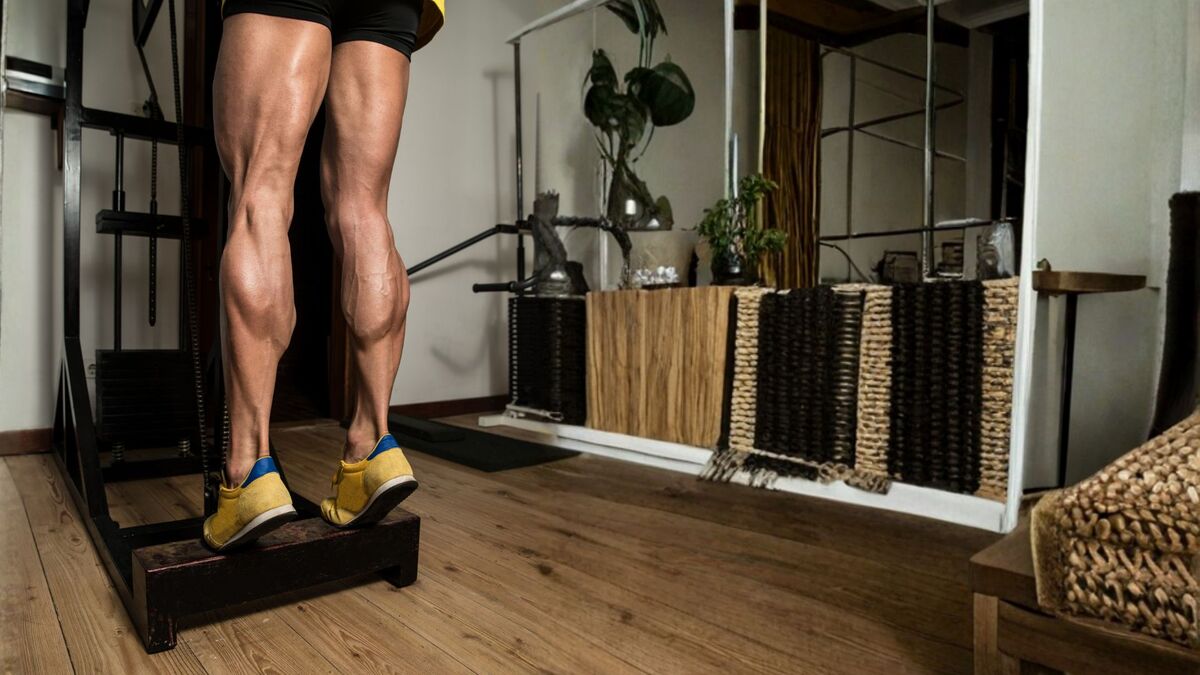
For Achilles tendinopathy, HSR often involves heavy calf raises. These can be progressed from bilateral to unilateral and eventually to a seated calf raise to specifically target the soleus, which handles massive loads during activities like running or jumping.
Exercise Video of Heavy Slow Resistance of the Achilles Tendon
Here's a video exercise from the Embodia HEP library showing HSR of the Achilles tendon.
Specialized Loading of the Patellar Tendon:
When dealing with the knees, HSR focuses on slow squats or leg presses. It is vital to monitor depth and ensure the load is heavy enough to stimulate the tendon without causing joint irritation.
Specialized Loading of the Wrist Extensors (Tennis Elbow):
The same HSR principles apply to lateral epicondylalgia, commonly known as tennis elbow. Heavy, slow-tempo wrist extension loading, rather than high-rep, low-load exercises, helps build tolerance in the wrist extensor tendon at its attachment to the lateral epicondyle, following the same 3-second concentric, 3-second eccentric tempo used for the Achilles and patellar tendons.
Research published in the American Journal of Sports Medicine (Couppé et al.) has examined HSR training as part of the treatment approach for lateral elbow tendinopathy, reflecting the growing evidence base for this method beyond the lower limb.
Exercise Video of Heavy Slow Resistance of the Wrist Extensors
Here's a video exercise from the Embodia HEP library showing HSR wrist extension with a dumbbell.
Addressing Sport Demands and Functional Recovery
Rehabilitation doesn't end when the patient is pain free at rest. We must prepare the tissue for sport demands. This
means transitioning from HSR to energy storage activities like plyometrics, sprinting, or sport-specific movements
(e.g., the high-impact landings found in climbing or the eccentric strain of skiing).
Beyond Loading: A Holistic Approach
While loading is king, we shouldn't ignore other factors:
- Stretching: While not a primary treatment for tendinopathy, maintaining functional range of motion in the surrounding joints is helpful.
- Corticosteroid Injections: Current sports medicine consensus (e.g., Cook JL) warns against frequent corticosteroid injections, as they may provide short-term relief but can weaken tendon structure and inhibit long-term healing.
- Kinetic Chain Deficits: Addressing weakness in the hips or core ensures the tendon isn't overworking to compensate for lack of muscle strength elsewhere.
Creative Home Modifications
Proactively adapt these heavy-loading principles for populations without access to a gym. Heavy backpacks, resistance bands, and even household items can bridge the gap. The goal is to reach that 7RM threshold where the muscle and tendon are sufficiently challenged.
Conclusion: Embracing the Future of Tendon Care
By integrating Heavy Slow Resistance into our protocols, we provide evidence-aligned, patient-centered care. HSR offers a scientifically supported path that respects the biological need for rest and recovery while pushing the limits of what the body can achieve.
Exciting News: HSR is Now Available on Embodia!
We are thrilled to announce that Embodia has added an extensive library of Heavy Slow Resistance (HSR) exercises to our platform! You can now easily find, assign, and track HSR-specific programs.
Clinicians can look forward to exercises with;
- Tempo Focus: Clear instructions and visual cues to help patients nail that crucial 6-second total time under tension.
- Creative Home Modifications: Accessible, heavy-loading alternatives designed specifically for patients who don't have access to heavy kettlebells or a leg press.
We've also added a patient education handout on HSR, written specifically to help your patients understand why you've prescribed this approach: what the protocol involves, what to expect, and answers to the questions patients ask most (how much discomfort is normal, whether they can keep training or playing sport, and whether HSR works without gym access). Share it directly through Embodia to reinforce your in-clinic explanation and improve patient buy-in.
These new resources will help clinicians optimize tendon rehab outcomes, improve load tolerance, and support the long-term healing of chronic tendinopathy.
Learn more about HEP on Embodia!
Related Learning
Here are two articles to expand your understanding of HSR:
- Putting “Heavy” into Heavy Slow Resistance
- Heavy Slow Resistance Versus Eccentric Training as Treatment for Achilles Tendinopathy: A Randomized Controlled Trial
---
Date published: 11 May 2026
Last update: 24 June 2026