
Dermoneuromodulation (DNM) for Pain: What It Is
By: Diane Jacobs, PT; Megan Zhu, MScPT Student; Jashandeep Mangat, MScPT Student; Editor: Nataliya Zlotnikov MSc, HBSc ∙ Estimated reading time: 7 minutes
By: Diane Jacobs, PT; Megan Zhu, MScPT Student; Jashandeep Mangat, MScPT Student; Editor: Nataliya Zlotnikov MSc, HBSc ∙ Estimated reading time: 7 minutes
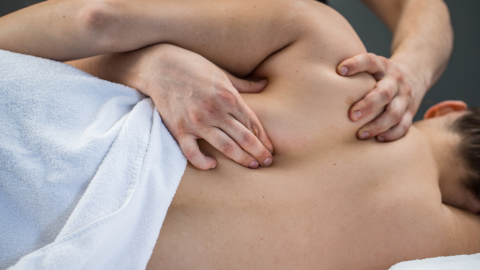
The Dermo Neuro Modulation Approach to Manual Therapy
For many, manual therapy looks like aggravating the patient and leaving them feeling more in pain than when they came in, but Diane Jacobs introduced a structured, interactive approach to manual therapy called Dermoneuromodulation that provides a different way of approaching the problem.
To begin, most of our training as physiotherapists and healthcare professionals hardly includes the sensory nervous system (more on the sensory nervous system below). It may have been mentioned, but it was not investigated. When learning about the nervous system, the sensory division was often not taught as part of a context for us being out in the world, treating patients.
But how else are we going to get information or new input into another person's nervous system unless we consider the sensory nervous system?
Our brains get information from the environment through the sensory nervous system - whether it be the eyes, the ears, etc. And then the brain will do all sorts of predictive processing and will decide to believe whatever it wants.
The brain wants to believe what it wants to believe. And that goes for absolutely everybody and absolutely every patient. So we have to deal with that factor, which is kind of a hurdle.
We're going to begin by exploring how critical the nervous system is for our function and then learn how to communicate with it.
Blog Outline
- Parts and Roles of the Nervous System
- What the Nervous System Needs for Optimal Function
- 3 Things to Know About Pain
- So Then What is the Sensory Nervous System?
- What is pain and how can manual therapy help with it
- 3 Ways Manual Therapy Helps with Pain
- Dermoneuromodulation - what is it?
Parts and Roles of the Nervous System
The nervous system consists of two main parts: The central nervous system (CNS), and the peripheral nervous system (PNS).
Our brain and spinal cord make up the central nervous system, and the 72 kilometres of peripheral nerves that branch off from the spinal cord and run throughout our body make up the peripheral nervous system. Compared to other systems in our body, the nervous system has the most excitable cells, meaning they don’t require a lot of stimuli to fire and are pretty responsive to touch and to being treated.
Furthermore, our nervous system is responsible for 100% of our function, even when we are asleep or awake. It makes sure we are breathing and makes our heart beat.
With such an extensive job, the nervous system requires a lot of fuel, about 25% of our available glucose and oxygen at all times to be precise.
So what happens when the nervous system doesn’t get the fuel it needs? Well, it will get grumpy and let you know it’s not happy (might give you pain), however, it won’t completely stop functioning.

Image source: BC Open Textbooks
What the Nervous System Needs for Optimal Function
Nerves need a steady blood supply, which they get from nearby vessels that branch into the nerve itself. Normally, that supply is generous (Sonawane et al., 2023). The weak spot is drainage: even low pressure on a nerve can disrupt blood flowing out of it, which may explain why nerve symptoms often appear in sustained positions and ease with movement. If this continues, the nerve can swell, become more sensitive, and glide less freely (Schmid et al., 2020).
DNM proposes that gentle movement of the skin and surrounding tissues may help support a nerve's circulation. This fits the physiology, but it hasn't been directly tested.
Therefore, for our nervous system to be running optimally, it’s essential that it has good blood flow as that is how the blood and oxygen will get delivered. With every nerve, there will always be an artery accompanying it to deliver oxygen to it. And delivering blood to the nerve isn’t the problem, as nerves are high-pressure vessels. The main concern is poor drainage from a nerve, often due to a lack of movement. This can lead to nerves becoming filled with deoxygenated blood and becoming thicker making them more susceptible to becoming trapped.
3 Things to Know About Pain
-
Pain and nociception are two separate things
- People commonly associate pain with nociception, but they are two separate things.
-
Nociception is a sensory input that encodes noxious stimuli
-
Pain is an output from a combination of cognitive, emotion-related, and sensory-signalling brain areas
-
- People commonly associate pain with nociception, but they are two separate things.
-
Pain is both a sensory and emotional experience
- The International Association for the Study of Pain (IASP) defines pain as "an unpleasant sensory and emotional experience associated with, or resembling that associated with, actual or potential tissue damage" (IASP, 2020).
-
Requires conscious perception to have pain
-
Pain is hard to ignore and interferes with movement
-
- The International Association for the Study of Pain (IASP) defines pain as "an unpleasant sensory and emotional experience associated with, or resembling that associated with, actual or potential tissue damage" (IASP, 2020).
-
Sometimes pain comes from an irritated nerve
-
- Pain can have several sources, and nerves are one of them. Compressed or irritated nerves are the most common cause of neuropathic pain (Schmid et al., 2020).
- Sustained pressure on a nerve can disrupt the blood draining out of it. Over time, this can lead to swelling and a more sensitive nerve (Schmid et al., 2020).
- DNM proposes that this kind of “grumpy nerve” contributes to more pain presentations than we often recognize. This is a working hypothesis that hasn't been directly tested.
So Then What is the Sensory Nervous System?
Now that we understand how our nervous system plays such an essential role in our function, it begs the question of how we start communicating with it. Well, It begins with the sensory nervous system.
We're going to explore the sensory nervous system,because that is our best option to help patients.

Somatosensory receptors are either interoceptive or exteroceptive.
In physical therapy school, we learn about all the different types of receptors in our somatosensory system with a focus on muscle spindles. However, spindles don't register exteroceptive input. They register interoceptive input. On the other hand, cutaneous receptors register exteroceptive input, meaning they inform us when stimuli are applied externally to our bodies.

Image source: Musician's Health Collective
Cutaneous nerves are found all over the body. You can think of a cutaneous nerve as a long highway that may travel from your hindbrain as far down to your big toe. On the highway, there are many different lanes that are subdivisions of the highway and run down it longitudinally. You can think of these lanes as fascicles, long tubes that contain cutaneous rami.
Along the highway, you may need to eventually exit to arrive at a specific location. These exit roads are cutaneous rami, branches of the nerve that eventually innervate your skin. So, as soon as you're on the skin, you're actually moving and touching cutaneous neural rami.

Image source: Cutaneous nerve
The Skin and Nervous System
To learn more, watch this video from Diane Jacob's course, Dermoneuromodulating: Treating the Patient as if Their Nervous System Really Mattered.
Click here for the
whole course
What is Pain and How Can Manual Therapy Help with It?
We work with patients living with pain a lot. So many of your patients come in and report they are experiencing some sort of pain. So before we begin about what we can do about it, let’s talk about what pain really is.
3 Ways Manual Therapy Helps with Pain
-
Manual Therapy is a novel stimulus that invites the nervous system to self-correct
-
The nervous system is predictive and not reactive. With manual therapy, we are deliberately providing an external stimulus that is novel to the nervous system. When a novel stimulus is introduced that is appreciated and welcomed, we hope it will persuade the brain to change what it is currently doing and self-correct
-
-
Manual therapy provides new input that may decrease firing from the top down
-
This is most likely due to descending modulation
-
The nuclei in the brainstem receive stimuli from the environment
-
Neurons from the brainstem nuclei descend onto the dorsal horn at various spinal cord levels
-
-
Along with the sensory neuron that goes up to the brain, there are also collateral branches that inhibit the transfer of nociceptive information.
-
Nociceptive neurons are heavily modulated by both descending mechanisms and large fibre collateral branches in the spinal cord
-
-
Manual therapy may support nerve circulation when drainage is poor or a nerve is entrapped
-
Due to a whole host of reasons such as metabolic conditions, tension patterns related to misuse or disuse, and nervous movement through tight tunnels formed by stiff tissue boundaries.
-
The regional vessels that accompany nerves can be deformed and as a result, perform inadequately
-
The regional vessels that accompany nerves can be deformed and as a result, perform inadequately
-
When we move the skin, we also move the cutaneous rami and the regional vessels that follow them. DMN proposes that shifting these vessels out of a position that limits drainage may help them drain blood more effectively. As with the circulation idea above, this fits the physiology but hasn't been directly tested.
-
Learn more with Diane Jacobs
Dermoneuromodulation - What is It?
Dermoneuromodulation (DNM) is an interactive and light form of manual therapy used to facilitate change in the nervous system. It adopts the idea that in order to facilitate changes in pain and motor outputs, the focus of the treatment needs to be on the nervous system.

By moving the skin in a slow and light fashion away from the area of pain, the aim is to create more space for the grumpy nerve to move. Furthermore, DMN utilizes comfort-inducing positions to ease the mechanical deformation of nerves and may help reduce noxious stimuli. By introducing these comforting and soft stimuli, the intention is for the nervous system to recognize it and correct itself through a top-down approach.
As DNM is an interactive form of manual therapy, having excellent communication with the patient and ensuring they are in charge is essential. DNM will not replace everything that physical therapists have learned in the past and is an adjunct to other parts of therapy.
In This Online Course by Diane Jacobs, You Will Learn:
- Increased awareness of the role the nervous system plays in pain production, and in response to manual therapy
- Better ways of accessing and communicating with the nervous system on every level
- Appreciation for the cutaneous nervous system
- A science-based method of manual therapy handling that takes into account what has been learned in neuroscience and pain science over the last couple of decades
- Better palpation skills and motivation to have manual therapy hands that are warm, slow, light, kind, effective, responsive, and intelligent.
Audience
Anyone with a license to touch people who treat patients with pain.
Diane Jacobs Discusses Her Course
Take a look at this short video in which Diane Jacobs discusses the goals of her course, Dermoneuromodulating - Treating the Patient as if Their Nervous System Really Mattered.
Click here for the full course
References
-
International Association for the Study of Pain. (2020). IASP announces revised definition of pain. iasp-pain.org
-
Schmid, A. B., Fundaun, J., & Tampin, B. (2020). Entrapment neuropathies: A contemporary approach to pathophysiology, clinical assessment, and management. Pain Reports, 5(4), e829. https://doi.org/10.1097/PR9.0000000000000829
-
Sonawane, K., Dixit, H., Jayaraj, A., Thota, N., & Sekar, C. (2023). “Knowing it before blocking it,” the ABCD of the peripheral nerves: Part A (nerve anatomy and physiology). Cureus, 15(7), e41771. https://doi.org/10.7759/cureus.41771
---
Date published: 30 Nov 2020
Last update: 04 November 2026

PT
Diane Jacobs graduated from U. Sask with a physiotherapy diploma in 1971, started using manual therapy in 1983, and went solo in 1994. She has been interested in pain science and working cutaneous nerves into the manual therapy story since 1998; she calls this ‘dermoneuromodulating’.
She helped to found the Canadian Physiotherapy Association Pain Science Division in 2009 and served on it until 2014.
In 2016 she published a book, DermoNeuroModulating. She retired in 2020 from practice and teaching, but still answers questions and maintains a DNM Facebook group.